Orchestration
The Five Ages of Computing
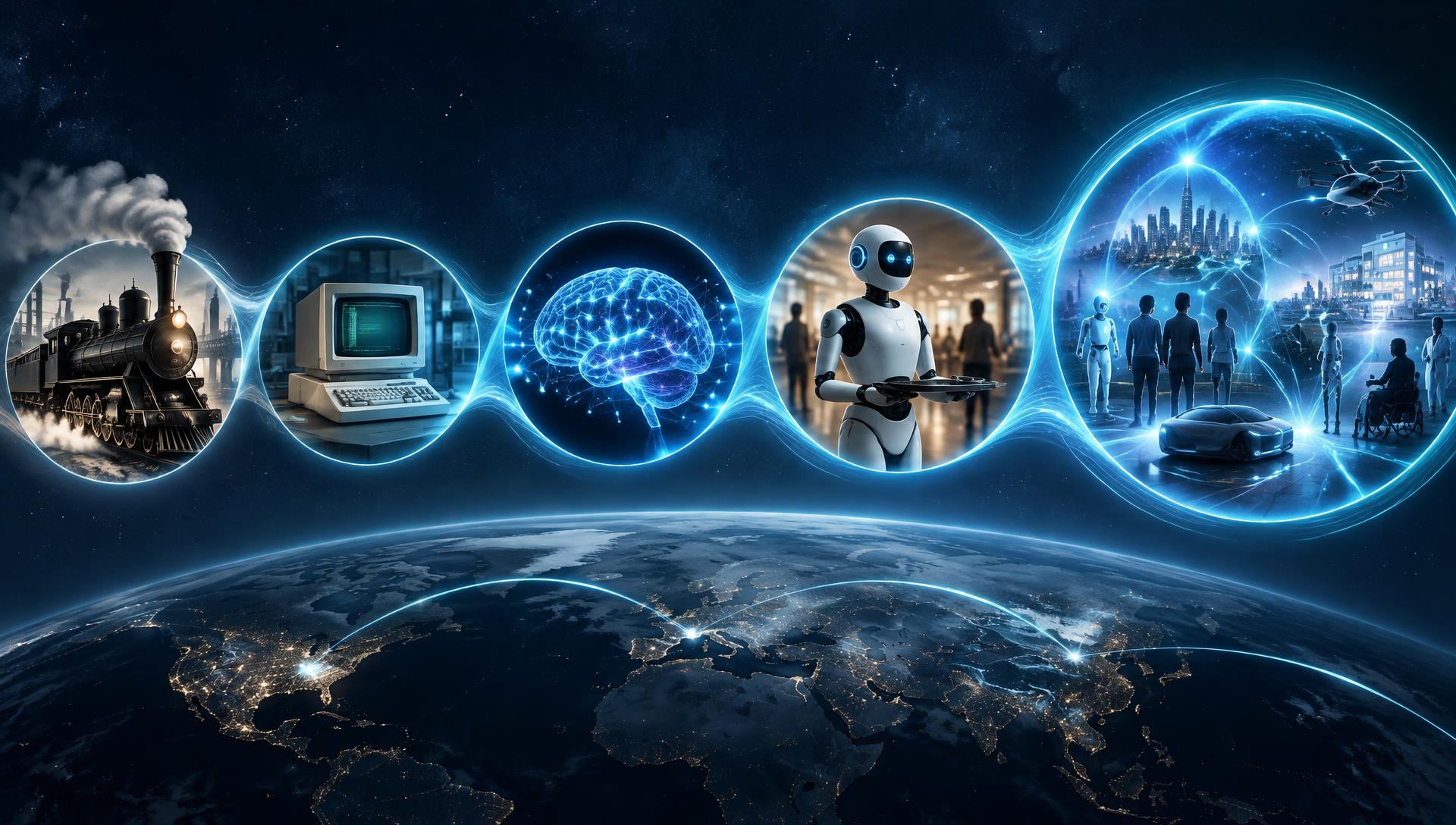
Every technological era multiplied something. The next one will multiply action.
We tend to remember technological revolutions by the products they created. The steam engine. The personal computer. The internet. The smartphone. Artificial intelligence. But the technologies that truly reshape society do something more important than introduce a new product category. They expand what human beings are capable of accomplishing.
For most of my career, I have watched one computing era give way to another. Networks connected businesses that had previously operated as islands. Cloud computing turned infrastructure into software. Mobile put that software into everyone's hands. Today, artificial intelligence is changing our relationship with knowledge itself. But I don't believe AI is the final destination. It is one stage in a much longer progression.
I think about that progression as five ages: Mechanization, Digitization, Intelligence, Autonomy, and Orchestration. Each age builds on the one before it, and each multiplies a different dimension of human capability.
Mechanization Multiplied Strength
The first transformation was physical. For most of human history, the amount of work society could accomplish was constrained by the strength of people and animals. Mechanization changed that equation. Steam engines, industrial machinery, railroads, and eventually electrically powered factories allowed relatively small numbers of people to control enormous amounts of mechanical energy.
What mattered wasn't simply that machines could perform physical work. Mechanization changed how work itself was organized. Factories emerged around machinery. Transportation networks reorganized commerce. Cities grew around industrial centers. Entire professions, supply chains, and economic systems developed around our newfound ability to multiply human strength.
That pattern is important because it repeats.
Digitization Multiplied Information
Computers introduced a different kind of leverage. Instead of multiplying muscle, they multiplied our ability to create, store, process, copy, and distribute information.
I have spent much of my career inside this era. Enterprise networking connected offices. Voice over IP transformed communications. Cloud computing moved infrastructure out of buildings. Smartphones made computing continuously available. Healthcare digitized medical records and clinical communication.
In recent years, much of my work has focused on that last piece: putting secure smartphones, clinical messaging, alarm notification, and managed devices into the hands of nurses and care teams. It taught me something that I think applies far beyond healthcare. The device in a clinician's pocket became the place where everything converges. Alerts from monitors, requests from colleagues, results from the lab, and messages from the EHR all arrive on one screen, carried by one person, in the middle of a shift.
That convergence was a genuine leap. But it also revealed the limit of the digital era. Every one of those messages still ends with a human being deciding what to do and then going to do it. Digitization made information flow beautifully. It did not make work flow.
Artificial intelligence began to change that boundary.
Intelligence Multiplies Knowledge
AI represents something fundamentally different from traditional computing because machines are no longer limited to processing explicitly defined instructions. They can recognize patterns, interpret language, understand images, synthesize enormous quantities of information, generate new content, and increasingly reason through complex problems.
That changes the economics of knowledge.
A physician can use AI to synthesize years of clinical information. An engineer can generate software in minutes. An organization can analyze millions of interactions that no human team could realistically review. Expertise that once required significant time to access can increasingly become available almost instantly.
But there is still an important limitation. Most AI today ultimately produces an answer for someone else to act upon.
The physician still coordinates the care. The nurse still finds the equipment. The dispatcher still sends the vehicle. The technician still receives the assignment. Someone still takes the intelligence produced by the system and converts it into work.
That brings us to the transition happening now.
Autonomy Multiplies Action
In September, I wrote that autonomy may represent the next industrial revolution because it changes the relationship between intelligence and execution. Once an intelligent system can understand what is happening, determine what should happen next, and take action within defined boundaries, computing stops being purely informational.
This is why I think autonomous vehicles, humanoid robots, AI agents, intelligent factories, and autonomous healthcare workflows belong in the same conversation. They may look like completely different technologies, but they share the same architectural transition: intelligence is becoming capable of action.
Consider something as ordinary as moving things. Every day, hospitals and health systems move lab specimens, medications, blood products, supplies, equipment, and patients across floors, buildings, and campuses. Today, most of that movement depends on people: a runner, a courier, a transporter, a nurse who walks the sample down herself because it is faster than waiting.
Robots and autonomous vehicles are increasingly capable of doing that physical work. But having spent a good deal of time on this problem, I have come to believe the hard part isn't the driving or the navigation. The hard part is trust. Who requested this movement? Who authorized it? Where was the item at every moment? Did it stay within the right conditions? Who received it, and can we prove it? In healthcare, a specimen with a broken chain of custody is a specimen that has to be drawn again. A controlled substance without an accountable handoff is a compliance problem.
Autonomous action only becomes useful in a regulated environment when every action is accountable. That means autonomy needs more than intelligence. It needs identity, verification, and an unbroken record of what happened.
The objective isn't to remove the clinician. It is to allow technology to execute more of the operational work surrounding the clinician, and to do it in a way the organization can stand behind.
That is a very different future from simply giving everyone a better chatbot.
Orchestration Multiplies Everything
There is one more stage, and I believe it may ultimately be the most important.
If AI agents can act, robots can move, vehicles can drive, buildings can respond, devices can communicate, and software can initiate work independently, we eventually encounter a new problem: Who coordinates all of it?
This is the orchestration problem.
A hospital cannot have hundreds of autonomous systems independently optimizing their own objectives. Neither can a factory, logistics network, transportation system, or city. These systems need identity, permissions, priorities, context, governance, and a common understanding of the larger objective.
What I find most interesting is that the two areas I have spent the most time on turn out to be two halves of the same problem. Clinical communications coordinates the humans. Autonomous transport coordinates the machines. Orchestration has to do both, and it has to hand work back and forth between them without losing track of anything.
Picture a discharge. A physician signs the order. The system recognizes that the patient's take-home medications need to come up from pharmacy, so it dispatches an autonomous delivery and records every handoff along the way. When the medications arrive, the nurse's phone receives a single, verified notification instead of a phone call and a hunt. Environmental services is queued for the room. Transportation is scheduled. The family receives an update. No one had to be the connective tissue. People stayed in control of the decisions, and the system carried the coordination.
That is why my thinking keeps returning to the concept of an operating system. In healthcare, I have argued that the next platform must coordinate people, applications, devices, workflows, and increasingly AI. As autonomy matures, that same architecture will need to coordinate software agents, robots, vehicles, physical infrastructure, and humans simultaneously.
The ultimate opportunity may therefore not belong to the company that builds the smartest individual AI model or the most capable robot. It may belong to the organizations that figure out how to make thousands or millions of intelligent participants work together safely, accountably, and toward a common objective.
Five Ages, One Direction
Seen together, the progression becomes clearer. Mechanization multiplied human strength. Digitization multiplied information. Intelligence multiplies knowledge. Autonomy multiplies action. Orchestration connects those capabilities into systems capable of operating at a scale no individual person could coordinate.
These ages don't replace one another. We still depend on machines, computers, networks, and software created during every previous era. The phone in a nurse's pocket still matters in an autonomous hospital. In fact, it matters more, because it becomes the point where people and machines meet. Each new layer increases what can be built on top of the layers beneath it.
That is why I think the current conversation about AI is simultaneously incredibly important and still too narrow. AI is not simply another software category. It is the intelligence layer that makes the next stages possible.
The more interesting question is what happens when that intelligence begins to act.
And after that, what happens when everything capable of acting begins working together?
That is where I believe we're headed.
This article is part of my monthly series exploring AI, autonomy, healthcare, robotics, connected mobility, and the systems required to orchestrate them. I publish one new perspective each month as we work through what the transition from software to intelligent, autonomous systems will mean for healthcare and the industries around it.
Continue reading
- Autonomy Is the Next Industrial Revolution
- Healthcare's Biggest Problem Isn't AI. It's That Hospitals Don't Have an Operating System.
- Agentic AI: The Future of Healthcare Isn't Smarter Software—It's Smarter Workflows
- Is AI Influencing Private Equity's Next Pivot?
- The Age of Autonomy
- Spec-Driven Development
- Evals Are the New Unit Tests
- The Mission-Critical Stack
- Buy, Build, or Orchestrate
- Autonomous Transport for Rural Health